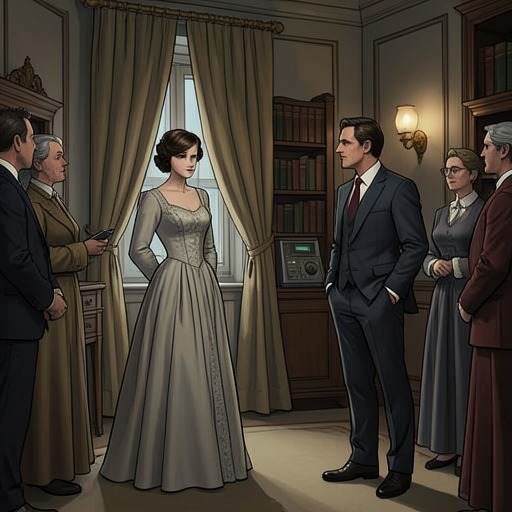
Adam Vizman left the family
Les Choses humainesAdam Wizman’s decision to leave his wife and daughters for Claire Farel is not a clean break but a long-delayed choice between a family life shaped by shared history and religious obligation, and a passion that has made his settled existence feel alien. His departure fractures the household and costs him his teaching position, while exposing how intimate decisions in the novel are bound up with communal belonging, fear, and the possibility of starting over.
Background and competing loyalties
Adam had built a life with his wife over nearly twenty years. They had two daughters, and he had remained faithful to a marriage in which she supported his professional projects and cared for their children. At her request, he sang a traditional Friday-evening song celebrating the virtuous woman. Yet their intimacy had come to seem serene, codified, and increasingly devoid of desire.
The family’s sense of Jewish identity was inseparable from fears about survival. After the 2012 attack on the Jewish school attended by their daughters, Adam and his wife withdrew the girls from the school and moved to Israel, settling in Ra’anana. The experience failed: Adam felt he could not integrate without deforming himself, and he was troubled by the political disengagement he perceived among fellow emigrants. The family returned to France, where Adam taught French at a Jewish school and lived within a close communal world. His wife became more observant, took the name Sarah, adopted modest dress, and sought stricter observance of dietary rules, Shabbat, and the laws of family purity. During menstruation and the prescribed period afterward, the couple did not sleep together; Sarah slept on a mattress on the floor, an arrangement Adam could not bear to see.
Passion and hesitation
At forty-two, Adam met Claire and experienced a forceful erotic and emotional attachment unlike the placid marital sexuality he had known. Their relationship unfolded largely through a secret, erotic correspondence and had not yet been tested by ordinary shared life. It nonetheless made Adam see his marriage as alienating and left him imagining that, with Claire, he could become more fully himself.
Leaving also meant risking his place in the community. Adam feared being treated as a pariah, a Jew who had abandoned his household, and he had been raised to believe that Jewish identity carried duties toward the survival of the people. The January 2015 attacks on Charlie Hebdo and the Hyper Cacher further intensified the family’s sense of shared vulnerability. For three days after the killings, Adam stayed home with his wife and daughters behind closed shutters; in his mind, their common exposure to danger bound them together more powerfully than love.
The conflict stretched on for months. Adam repeatedly came close to leaving, then retreated to the life whose foundations he had helped build. He worried about the effect of separation on his daughters, particularly his older daughter Mila, who remained psychologically vulnerable after the school attack and suffered nightmares and recurring thoughts of death. Claire, who wanted their relationship acknowledged openly, was more distressed by the stalemate. They broke up and returned to one another, each aware that their intellectual and sexual intimacy felt exceptional. Eventually Claire let go, interpreting the impasse through familiar ideas about midlife upheaval and the desire to reaffirm oneself. Then Adam told her he had made his choice: he would divorce.
The announcement and departure
In the days before telling his wife, Adam imagined tears, insults, threats, attempts at reconciliation, or intervention by a rabbi, friends, relatives, and members of the community. He had not imagined silence. His wife refused to speak to him or look at him, moving through the apartment as if he had become invisible and impure. Her refusal turned the announcement into a form of social and domestic erasure: Adam could still move and speak, but she treated him as though he no longer existed.
The next day, Sarah told the director of the Jewish school where Adam taught that he had left her for a non-Jewish woman with whom he had long been having an adulterous affair. Adam was fired. He packed a suitcase and went to join Claire in a Paris hotel room. A few days later, they rented a furnished apartment in the city’s thirteenth arrondissement and began living together. The departure therefore changed more than Adam’s marital status: it removed him from the family home and his communal workplace at once, while turning his private relationship into an openly consequential break.
Later consequences and narrative significance
Adam’s separation forms part of the family history surrounding the later Farel case. When Alexandre Farel was taken into custody on suspicion of rape, news of the accusation reached the press within hours. Alexandre’s lawyer publicly denied the allegations, while the case brought scrutiny and insults to Claire and Jean Farel as well. The novel places these public reverberations against the earlier intimate choices that had rearranged the family: Adam’s departure had already made Claire’s relationship with him a source of conflict and exposure.
The episode resists a simple opposition between desire and duty. Adam’s choice follows months of indecision, and the grounds for his hesitation are concrete: his daughters’ vulnerability, his wife’s years of loyalty, the religious community in which he lived, and the historical fear of Jewish disappearance. Yet remaining had come to feel like a life without desire or a future. His departure is decisive precisely because it does not resolve those competing claims; it gives him a new household with Claire while leaving the losses, family ruptures, and communal consequences in its wake.